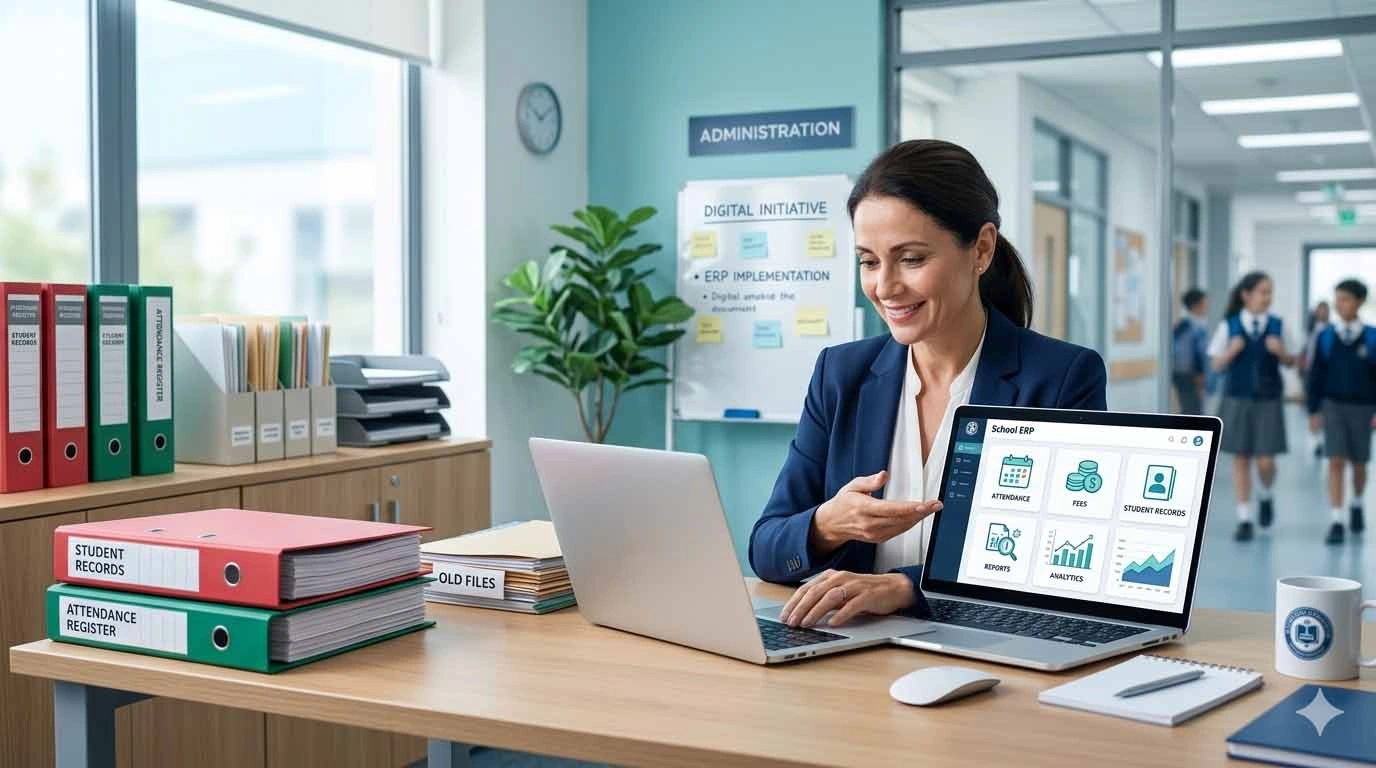
How School ERP Reduces Manual Work in Administration
Leave a commentA School ERP system helps reduce manual administrative work by digitizing student records, attendance, fees, exams, reports, staff data, communication, and daily office processes. It saves time, reduces errors, improves data access, and helps school management work more efficiently.
School administration involves many daily tasks. Student records, attendance, fee collection, exam marks, report cards, staff details, notices, documents, and communication all need to be handled carefully. In many schools, these activities are still managed through registers, paper files, Excel sheets, and repeated manual entries.
At first, manual work may look simple. But as the number of students, classes, staff members, and reports increases, manual administration becomes difficult, slow, and error-prone.
A modern School ERP system can reduce this manual workload and make the entire administration process more organized.
What is Manual Work in School Administration?
Manual work means doing administrative tasks by hand or by using disconnected systems. For example, maintaining student data in registers, calculating fees manually, preparing attendance reports from paper records, creating exam reports in separate files, or searching old documents physically.
These processes take time and depend heavily on human effort. If one record is entered incorrectly, it can affect reports, communication, accounts, and decision-making.
Common manual work in schools includes:
- Student admission records
- Daily attendance registers
- Fee collection and due calculation
- Receipt writing
- Exam marks entry
- Report card preparation
- Staff attendance and leave tracking
- Parent communication
- Notice management
- File and document handling
- Daily and monthly reports
A School ERP system helps bring these tasks into one digital platform.
- Reduces Repeated Data Entry
In a manual system, the same student information may be written in different places: admission register, class list, fee register, attendance sheet, exam record, and report card.
This creates duplicate work.
With a School ERP system, student information is entered once and can be used across different modules. The same data can support attendance, fees, exams, reports, ID cards, and communication.
This saves time and reduces mistakes.
- Makes Student Records Easier to Manage
Student records are very important for any school. Manually searching student details from files or registers can take a lot of time.
A School ERP allows administrators to search student information quickly by name, class, roll number, admission number, or other details.
This helps the school office respond faster to students, parents, teachers, and management.
- Simplifies Attendance Management
Manual attendance registers require daily writing, checking, and later calculation. Preparing monthly attendance reports from registers can be time-consuming.
A digital ERP attendance system helps teachers record attendance faster and allows the administration to generate reports more easily.
It can help track:
- Daily attendance
- Monthly attendance
- Absent students
- Attendance percentage
- Class-wise summaries
This reduces the time spent on manual calculations.
- Reduces Fee Collection Errors
Fee management is one of the most sensitive areas of school administration. Manual fee calculation may lead to errors in dues, concessions, receipts, or payment history.
A School ERP can manage fee structures, payment records, discounts, concessions, dues, receipts, and collection reports in an organized way.
This helps the accounts department work faster and reduces confusion.
- Speeds Up Exam and Result Work
Preparing exam reports manually is difficult. Teachers and administrators need to enter marks, calculate totals, assign grades, prepare report cards, and check mistakes.
A School ERP can organize exam marks and generate reports more efficiently. It can reduce repetitive calculations and help create result summaries faster.
This gives teachers more time to focus on academic improvement instead of paperwork.
- Improves Report Generation
School management needs reports for decision-making. Manual reports often take time because data has to be collected from different departments.
A School ERP can generate reports from stored data, such as:
- Student strength
- Attendance reports
- Fee collection reports
- Due reports
- Exam performance
- Staff records
- Daily collections
- Class-wise summaries
This helps management get information quickly and make better decisions.
- Helps Staff Work More Efficiently
A school office often handles many requests every day. Parents ask for fee status, teachers ask for class lists, students need certificates, and management needs reports.
If everything is manual, staff members spend a lot of time searching records.
With a School ERP, data is organized and easier to access. This improves staff productivity and reduces unnecessary pressure.
- Reduces Paper Dependency
Paper-based administration requires storage space, maintenance, and manual searching. Files can be misplaced, damaged, or difficult to update.
A digital system reduces dependency on paper and helps schools maintain cleaner, safer, and more accessible records.
Schools may still need printed documents for official purposes, but daily work becomes much easier when records are managed digitally.
- Improves Communication
Manual communication through paper notices or phone calls can be slow. A School ERP can support faster communication through notices, messages, emails, portals, or notifications, depending on the system design.
This helps schools communicate important information to parents, students, teachers, and staff more efficiently.
- Provides Better Control to Management
A School ERP gives management a clearer view of school operations. Instead of depending only on manual reports, management can check important information from dashboards and reports.
This improves transparency and control over daily administration.
How CodideX Helps Developers Build School ERP Interfaces
CodideX is a modern School ERP HTML template designed to help developers build school management software faster. It provides a professional front-end structure with dashboards, forms, tables, UI components, utility pages, and ERP-style layouts.
Developers can use CodideX as a starting point and connect it with their own backend technology and database.
This helps reduce the time needed to create the user interface and allows developers to focus more on actual ERP logic, reports, permissions, and custom school requirements.
Conclusion
Manual administration can slow down school operations and create unnecessary pressure on staff. A modern School ERP system helps reduce repeated work, improve accuracy, organize records, generate reports faster, and make communication smoother.
For schools, digital administration is not only about technology. It is about saving time, improving control, and creating a better working environment for everyone involved.
A well-planned School ERP system can help schools move from scattered manual work to a more organized and professional administrative process.