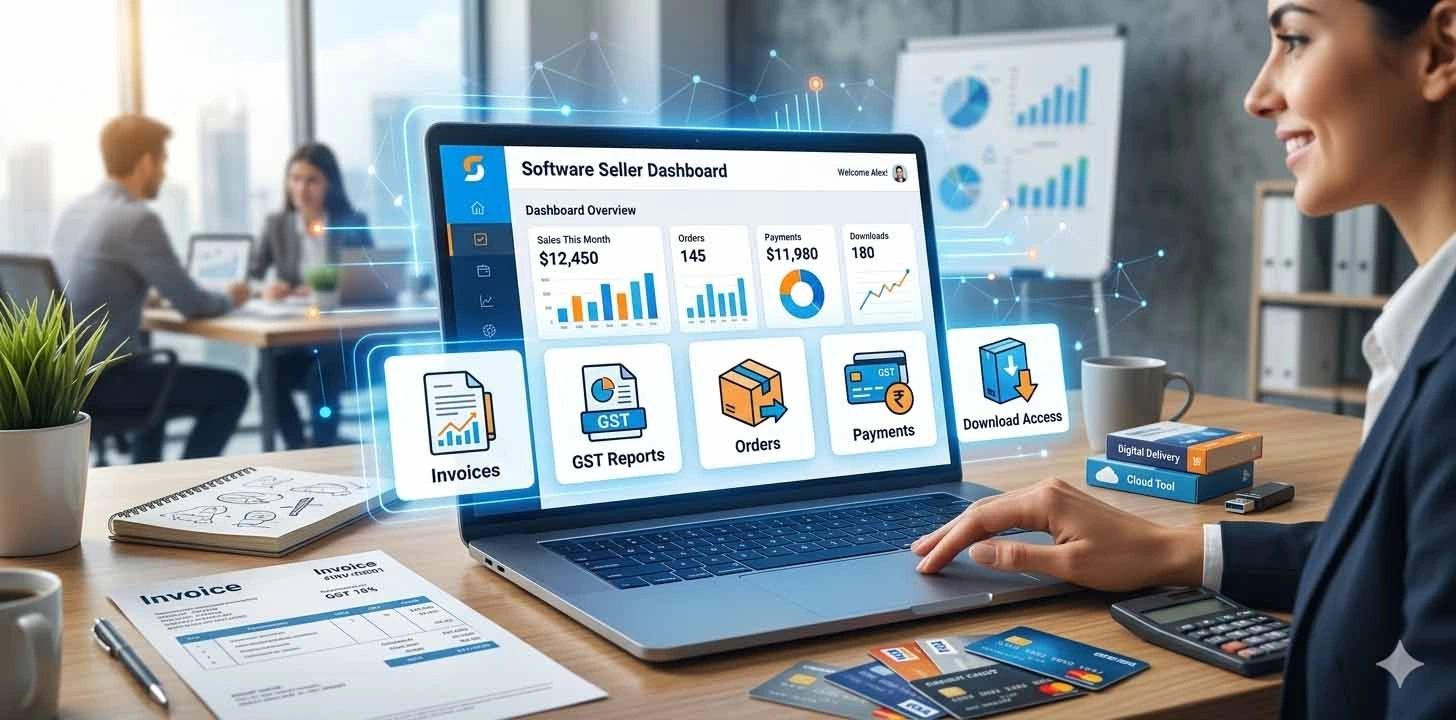
GST and Invoice Management for Online Software Sellers in India
Leave a commentOnline software sellers in India need proper GST and invoice management to maintain clean business records, generate professional customer invoices, track taxes, manage orders, and prepare reports for accounting. A well-organized invoice system helps digital product businesses work more professionally and avoid confusion.
Selling software and digital products online is becoming more common in India. Developers, agencies, startups, and small businesses now sell HTML templates, PHP scripts, plugins, source code packages, design files, digital tools, and other downloadable products through their own websites and online marketplaces.
But selling digital products is not only about uploading a file and receiving payment. A proper business system should manage orders, invoices, taxes, customer details, payment status, and downloadable access in an organized way.
For Indian software sellers, GST and invoice management play an important role in keeping the business professional and accounting-ready.
Why GST and Invoice Management Matters
When a customer buys a digital product, the seller should have a clear record of the transaction. The invoice should show important details such as seller information, customer information, order number, invoice date, product details, taxable value, GST breakup, discount, and total amount.
Without proper invoice management, it becomes difficult to answer basic business questions:
- Which customer purchased which product?
- Was the payment successful?
- What was the taxable value?
- Was GST charged correctly?
- Was any coupon discount applied?
- Which invoice was generated?
- What was the final order amount?
- Can the invoice be downloaded later?
A proper invoice system helps answer these questions quickly.
Basic GST Invoice Details
A GST tax invoice in India generally includes details such as the supplier’s name, address, GSTIN, invoice number, invoice date, recipient details, description of goods or services, taxable value, tax rate, tax amount, and total invoice value. The official GST invoice rules mention supplier name, address, GSTIN, invoice number, and date among required invoice particulars.
For an online software seller, invoice details may include:
- Business name
- GSTIN
- Business address
- Invoice number
- Invoice date
- Customer name and email
- Customer address/state/PIN if collected
- Product name
- SAC or HSN code if applicable
- Taxable value
- CGST / SGST / IGST breakup
- Coupon discount
- Grand total
- Payment status
- Payment ID or reference number
The exact tax treatment should always be checked with a qualified accountant or GST professional.
Why Software Sellers Need Order-Based Invoices
In digital product selling, one customer may buy one or more products in a single order. Each order should have a unique order ID and invoice reference.
Order-based invoice management helps sellers connect:
- Customer details
- Product details
- Payment status
- Coupon discount
- GST calculation
- Invoice PDF
- Download access
- Support history
This makes the entire business flow easier to track.
GST Breakup: CGST, SGST, and IGST
For Indian transactions, GST breakup may depend on the seller’s state and the customer’s place of supply. In many cases, intra-state sales may involve CGST and SGST, while inter-state sales may involve IGST.
A proper invoice system should store tax values clearly so that reports can be generated later.
For example:
- Taxable value
- CGST name and amount
- SGST name and amount
- IGST name and amount
- Total GST
- Grand total
This helps the business owner and accountant review sales correctly.
Coupon Discount and Tax Calculation
Many online sellers use coupon codes for promotions. But coupon discount should not be handled casually.
A proper system should clearly track:
- Coupon code used
- Discount amount
- Taxable value after discount if applicable
- GST amount
- Final payable amount
The order creation process should not blindly trust hidden form values or session values. It should revalidate the coupon and recalculate totals before creating the order.
This helps prevent calculation mistakes and misuse.
Payment Status and Invoice Generation
Payment status is very important in online selling. A system should clearly distinguish between:
- Pending payment
- Successful payment
- Failed payment
Invoice generation should normally happen after successful payment verification. Payment gateway verification should be treated separately from post-payment tasks like invoice PDF generation or email sending.
If payment is verified successfully but invoice email fails, the payment should not automatically become failed. Payment verification and invoice/email processing should be handled as separate responsibilities.
This kind of separation makes the system safer and more reliable.
Invoice PDF Management
A professional software-selling website should generate and store invoice PDFs for paid orders. This allows both the customer and admin to access invoices later.
Useful invoice PDF features include:
- View invoice
- Download invoice
- Print-friendly summary
- Invoice file existence check
- Proper invoice filename pattern
- Safe file path handling
The system should not expose internal server paths to users. It should show only safe web links or stream files securely where needed.
GST Reports for Admin
A digital product seller should not depend only on payment gateway reports. The website admin panel should provide its own GST and invoice reports based on stored order data.
Useful GST report features include:
- Date-wise sales report
- Invoice count
- Taxable value
- Total GST
- CGST / SGST / IGST breakup
- Coupon discount total
- Order status filter
- CSV export
- SAC-wise summary
- Print or PDF-friendly report
Such reports help in accounting and business review.
E-Invoicing Consideration
Some businesses in India may also need to follow e-invoicing rules depending on turnover and transaction type. E-invoicing applicability has been linked to aggregate turnover thresholds, and many guides note the ?5 crore threshold from August 2023 for applicable businesses. However, applicability can depend on category, exemption, and current GST rules, so sellers should verify with their accountant or the GST portal before implementing e-invoicing.
For smaller software sellers, normal GST invoice management may be enough at the starting stage. But the system should be designed in a structured way so that future compliance features can be added if required.
Why Customer and Download Access Should Connect with Invoice
For digital products, invoice management should not be isolated. It should connect with customer and download access records.
After successful payment:
- Order should be marked paid
- Invoice should be generated
- Customer profile should show the purchase
- Download access should be allowed
- Download logs should be tracked
- Admin should be able to manage access if needed
This creates a complete business flow.
How Codide Helps Digital Product Sellers
Codide is built with practical digital product business needs in mind. A complete system should not only show products and accept payments. It should help manage orders, invoices, GST reports, customers, download access, coupons, support messages, reviews, newsletters, and analytics.
For online software sellers, these connected modules can make the business more organized and professional.
A proper system helps answer important questions such as:
- Who bought the product?
- Which invoice was generated?
- Was GST calculated correctly?
- Did the customer download the file?
- Was any coupon used?
- Is support required?
- Can admin revoke or grant download access?
This type of control is important for a serious digital product business.
Conclusion
GST and invoice management are important parts of running an online software-selling business in India. A professional invoice system helps maintain clean records, improve customer trust, support accounting work, and connect payment, order, tax, and download access in one business flow.
For developers and businesses selling digital products, proper invoice and GST report management should be planned from the beginning.
A well-designed system can save time, reduce confusion, and make the business more reliable as it grows.